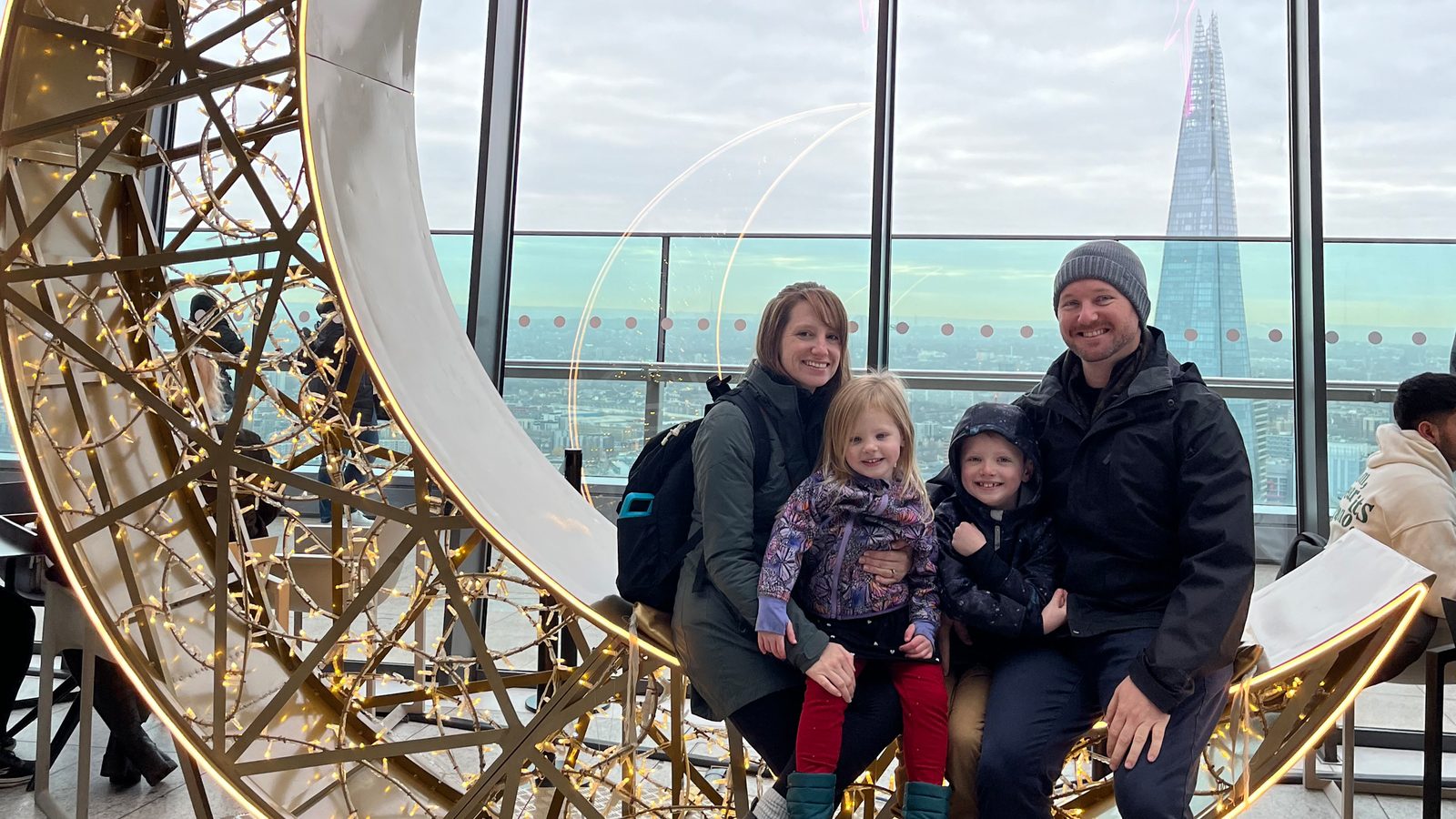
Somewhere around page forty of a UK government PDF, with Calvin asking me to play Minecraft and Amelia coloring on what may or may not have been an important document, I thought: this is insane. We're a family that lived in an Airstream for five years, and now I'm trying to convince the British government to let us stay permanently.
It worked. From the day I clicked submit to the day four approval emails landed in my inbox, it took exactly 38 days. Five-year UK visas for me, Carol, Calvin, and Amelia.
Here's how it actually went — the timeline, the cost ($35,150, and yes, I'll break that down), and everything I wish someone had told me before I started.
How Scotland snuck up on us
We didn't plan to immigrate. That's not how our family works. We plan one thing and end up doing something else entirely. (See: "Let's try van life for a year." Five years later, we're renovating a cottage in Scotland.)
The real shift happened during Christmas 2023 in Edinburgh. We weren't passing through. We were living there. Calvin had a favorite bookshop. Amelia had opinions about which market stall had the best hot chocolate. Carol was shopping for groceries, not souvenirs. At some point, "temporary" started feeling a lot like "home."
Then in early 2025, we spent a few months on the Isle of Skye. And that was it. The mountains, the pace, the way the kids settled into something that looked like roots for the first time in years. Carol and I started asking a different question. Not "where should we go next?" but "what would it take to actually stay?"
Why the UK (and not Portugal or Spain or Greece)
We looked at other European options. Portugal was appealing but the policy kept shifting. Spain had the lifestyle but the tax situation was complicated in ways I didn't love. Greece was beautiful but didn't line up well with the kind of work I do.
The UK won for a few reasons. Professionally, it's where my work in tech strategy makes the most sense — the ecosystem here is strong. But the bigger factors were practical. English-speaking schools for the kids. NHS access so we're not juggling private health insurance across borders. And a visa type that isn't tied to a single employer, which matters when your whole life is built around flexibility.
Carol cared most about the kids having continuity. Calvin's ten now. He needs friends who don't change every three months. He needs a school he can actually settle into. Amelia needs ballet on Saturdays and a routine that doesn't reset every time we cross a border. The five-year visa was the first piece of paperwork that let us think about their lives in years instead of months.
What Global Talent actually means
The UK Global Talent visa has two stages. Stage 1: get endorsed by an approved body (in my case, Tech Nation, which evaluates people in the tech sector). Stage 2: apply for the actual visa through UK Visas & Immigration.
Within Stage 1, you're either "Exceptional Talent" (established leaders) or "Exceptional Promise" (emerging leaders). I went for Exceptional Talent because it gets you the full five years upfront. No renewals, no check-ins, no wondering if you'll have to uproot the kids in two years.
The key thing about this route: it's not tied to an employer or a property purchase. You're assessed on your professional track record. For a family that's spent five years proving that you can work from literally anywhere, this was the natural fit.
The timeline (38 days, but months of prep)
Here's the actual calendar:
- July 14: Stage 1 endorsement application submitted
- August 2: Endorsement received (19 days)
- August 3: Stage 2 applications submitted for all four of us
- August 18: Biometrics appointment (four people, one session)
- August 21: Visas issued
38 days sounds fast. It was fast. But most of the real work happened in the months before that. The endorsement application alone took weeks of preparation — it's not a form, it's basically a portfolio.
The endorsement: harder than it looks
This is the part people underestimate. The Tech Nation endorsement requires a personal statement connecting your work to UK impact, a CV that shows leadership (not just technical skills), three recommendation letters from senior people who can vouch for you independently, and evidence documents that prove actual impact.
I approached it the way I'd approach any work problem: like a system. Each document existed to prove one specific thing. The whole package told one story. Clean file names, obvious structure, no fluff. Carol proofread the personal statement three times and each time said "this is good but it sounds like a robot wrote it." She was right every time. The final version was better for it.
The family application (where it gets chaotic)
Here's what nobody tells you about applying as a family: every person is a separate application. Me, Carol, Calvin, Amelia — four separate online forms, four separate fees, four separate document uploads, four separate biometrics captures. The kids don't get a free ride. A six-year-old needs the same paperwork as an adult. (Amelia's application listed her occupation as "child," which felt unnecessarily blunt.)
The hard part wasn't the complexity. It was keeping everything synchronized. Four applications that all needed to be submitted together, paid together, and linked to the same biometrics appointment. Carol built a spreadsheet. I would have done the same thing, but she beat me to it.
Biometrics: the part that almost broke us
You don't give your fingerprints to the UK government directly. You go to a Visa Application Center run by a third-party provider, and appointment availability is unpredictable.
For a family of four who needed to be at the same place at the same time, this was the hardest logistical problem of the entire process. We needed one location we could get to, with four appointment slots in one block, inside the endorsement validity window. It took more planning than some of our international moves.
Calvin was a champ. Sat still, did his fingerprints, didn't complain. Amelia needed some coaxing. There was a lollipop involved. Carol managed the paperwork flow while I managed the children, which is probably the correct allocation of skills in our family.
If you're doing this: check VAC appointment availability before you submit Stage 2. Don't find out there are no slots after the clock is already running.
The money ($35,150)
I'm going to share the real number because that's what we do here.
The all-in cost for our family: $35,150 for four five-year visas. The biggest chunk is the Immigration Health Surcharge — multiply it by four people and five years and it adds up fast. Then there are endorsement fees, individual visa application fees, priority processing, and the logistics of getting four people to a biometrics appointment.
It's not cheap. But here's how I think about it: over five years, that's about $7,000 per person. Compare that to shorter visas that need renewing every two years — repeat fees, repeat biometrics, repeat uncertainty about whether you'll be approved again. And meanwhile the kids can't commit to a school because you're not sure you'll be in the country next year. The five-year route costs more upfront but it buys you something money usually can't: the ability to plan.
The emails
When the four approval emails came through, I was sitting at the kitchen table in our rental on Skye. Carol was making tea. Calvin was reading. Amelia was doing something with glitter that I'm choosing not to investigate.
The feeling wasn't excitement. It was relief. The kind of deep, full-body relief that comes when something you've been carrying for months finally resolves. We could stay. Not as visitors, not on a rolling permission that might not get renewed, but as residents. For five years. Long enough for Calvin to finish primary school. Long enough to actually renovate the cottage instead of rushing it. Long enough to stop thinking about immigration and start thinking about living.
Carol hugged me and said "we did it," and Amelia looked up from her glitter and said "did what?" Which is probably the most accurate summary of parenting through a visa process.
What I'd do differently
- Start the recommendation letters way earlier than feels necessary. People are busy. Follow-ups are awkward. Give yourself runway.
- Map your evidence before you write anything. I made a grid: claim, criterion it proves, the artifact, and the supporting context. It forced the whole package to be coherent instead of just comprehensive.
- Check biometrics availability before submitting Stage 2. Seriously. This is the thing that will derail your timeline if anything does.
- The personal statement is not a cover letter. It's an argument. Treat it like one. Tight thesis, clear evidence, obvious UK connection.
- Build one shared folder from day one. When you're coordinating four applications, you need a single source of truth or you will lose your mind (and possibly a passport photo).
If you're thinking about this
"38 days" sounds like a flex. It isn't. It's what happens when you do months of preparation and then everything lines up. The Global Talent route rewards clarity and evidence more than credentials or pedigree. If your work has genuine impact, the system is designed to recognize that.
If you're considering this for your family and want a practical starting point — timeline templates, cost breakdowns, or just someone to tell you "yes, the biometrics part really is that stressful" — drop me a message. It's a much easier process when someone who's been through it hands you the map.