People ask about the electrical system more than anything else. More than the layout, more than the renovation, more than how we manage school on the road. They want to know how we keep the lights on. Fair question. When your home runs on batteries and sunlight, the electrical system isn't a feature. It's the foundation.
Here's everything: what we built, why we chose it, what it cost us in time and money, and what I'd change if I did it again.
The philosophy
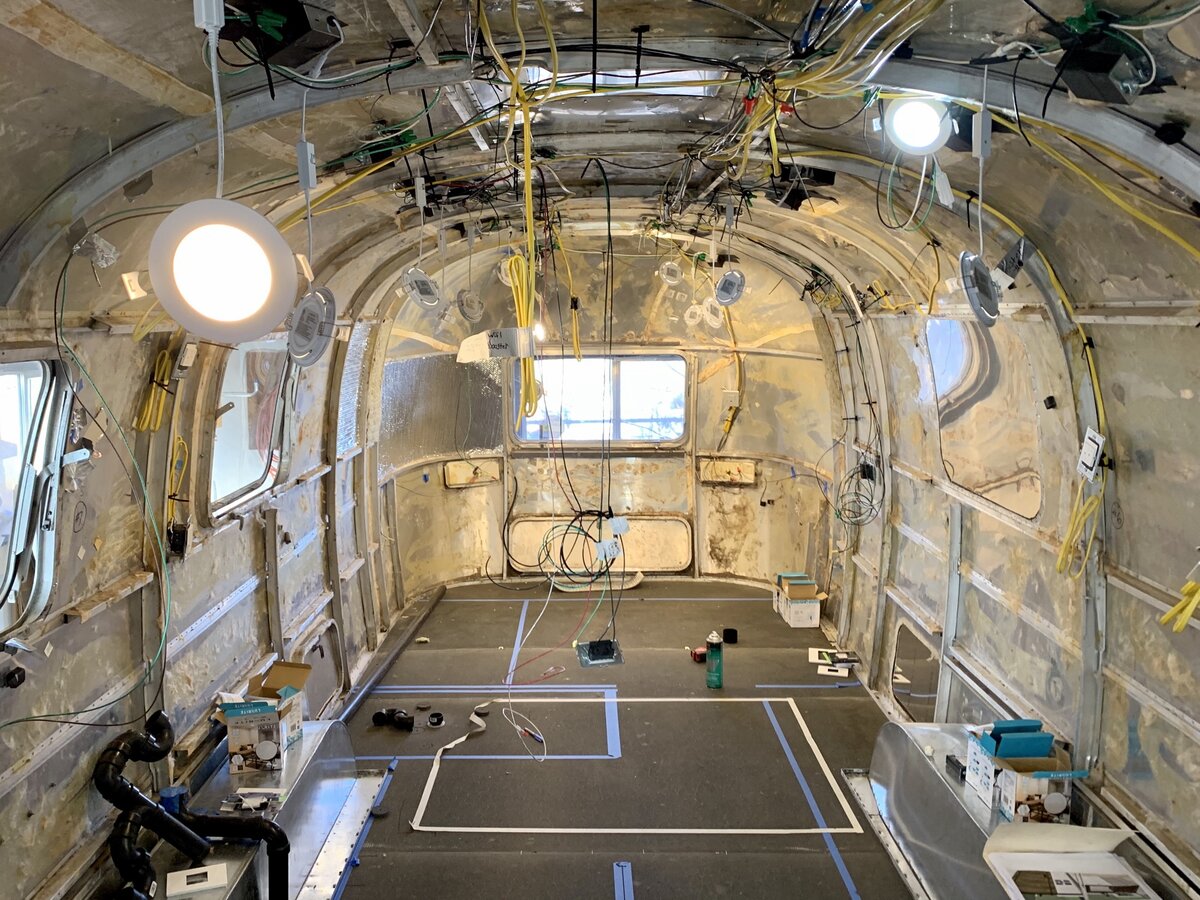
Most RV electrical systems are built around a compromise. The 12V side runs off the battery and handles the basics: lights, water pump, furnace fan. The 110V side only works when you're plugged into shore power at an RV park, or in limited capacity if you manually flip an inverter switch. It's two separate worlds that barely talk to each other, and the result is a home that only feels like a home when you're plugged in.
I didn't want that. I wanted Colletta to feel like a house. A real, sticks-and-bricks house where every plug always flows, every light switch always works, and you never have to think about which outlets are "live" and which ones aren't. I wanted Carol to be able to plug in a blender at a campsite in the middle of nowhere and have it just work, the same way it would in a kitchen in Salt Lake City.
That meant building the system around the inverter, not around shore power. The Victron MultiPlus runs continuously, converting battery power to 120V AC and feeding it to a standard residential breaker panel. Every outlet in the Airstream is on a dedicated circuit. The washer-dryer has its own breaker. The AC unit has its own breaker. The kitchen outlets have their own breaker. If something trips, I can isolate it in seconds without affecting anything else. When we plug into shore power, the MultiPlus seamlessly switches to pass-through and charges the batteries. When we unplug, it switches back to inverting. No manual intervention. No flipping switches. The power just works.
This approach costs more, weighs more, and requires more planning than a standard RV electrical setup. But it means we live the same way whether we're at an RV park with 50-amp service or dry camping on BLM land in the desert. That was the whole point.
The requirements
The philosophy drove the requirements. We needed to run air conditioning off-grid. With two small kids in the desert, that wasn't optional. We needed to run a washer-dryer, because cloth diapers and laundromat detours don't mix. We needed to charge laptops, phones, and work equipment, because I was working remotely and losing power meant losing income. And we needed to do all of this without plugging in, because the best campsites don't have hookups.
That set of requirements pushed me toward a bigger system than most Airstream builds. Most people get by with 400W of solar and 200Ah of lithium. We needed roughly double that.
Solar: 940 watts on the roof
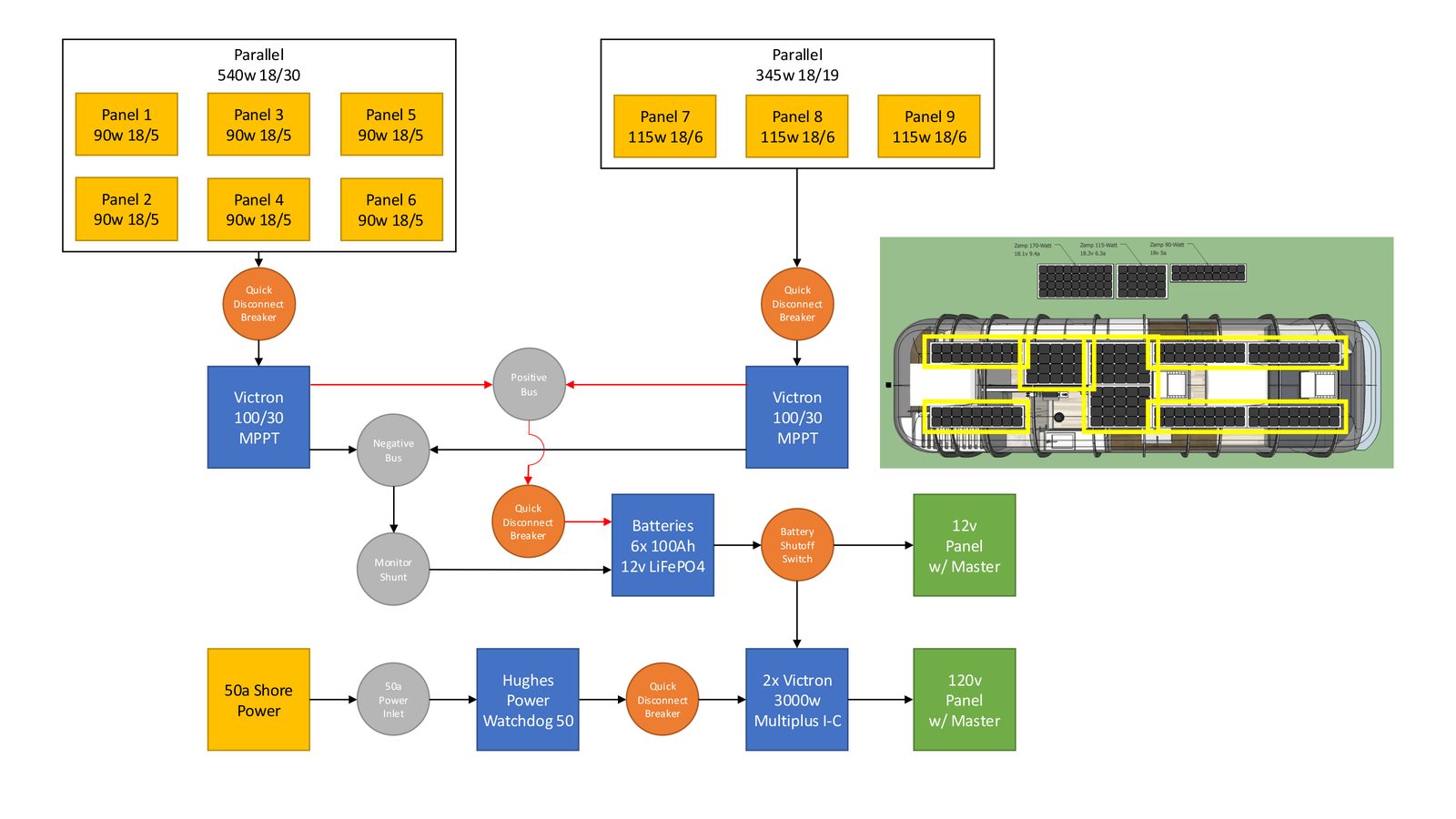
The roof carries a mix of Zamp solar panels: a combination of 170W, 115W, and 90W units, arranged to maximize coverage on the curved Airstream roof. Zamp was the right call for us because their panels are designed specifically for RV applications, they're lightweight, and they come with the mounting hardware that actually works on curved surfaces.
940 watts sounds like a lot, and it is. On a clear day in the desert, we can pull in more power than we use. On a cloudy day in the Pacific Northwest, we pull in about half of what we need and lean on the battery bank to cover the difference. The system was designed around the worst case, not the best case. If you size your solar for Arizona and then park in Washington, you'll be running a generator by day three.
The panels feed into two Victron MPPT charge controllers. MPPT (Maximum Power Point Tracking) controllers are more efficient than PWM controllers, especially when panel voltage doesn't perfectly match battery voltage. They cost more. They're worth it. Over a full day of charging, the efficiency difference can mean 15-20% more power into the batteries.
Batteries: 800 amp-hours of lithium
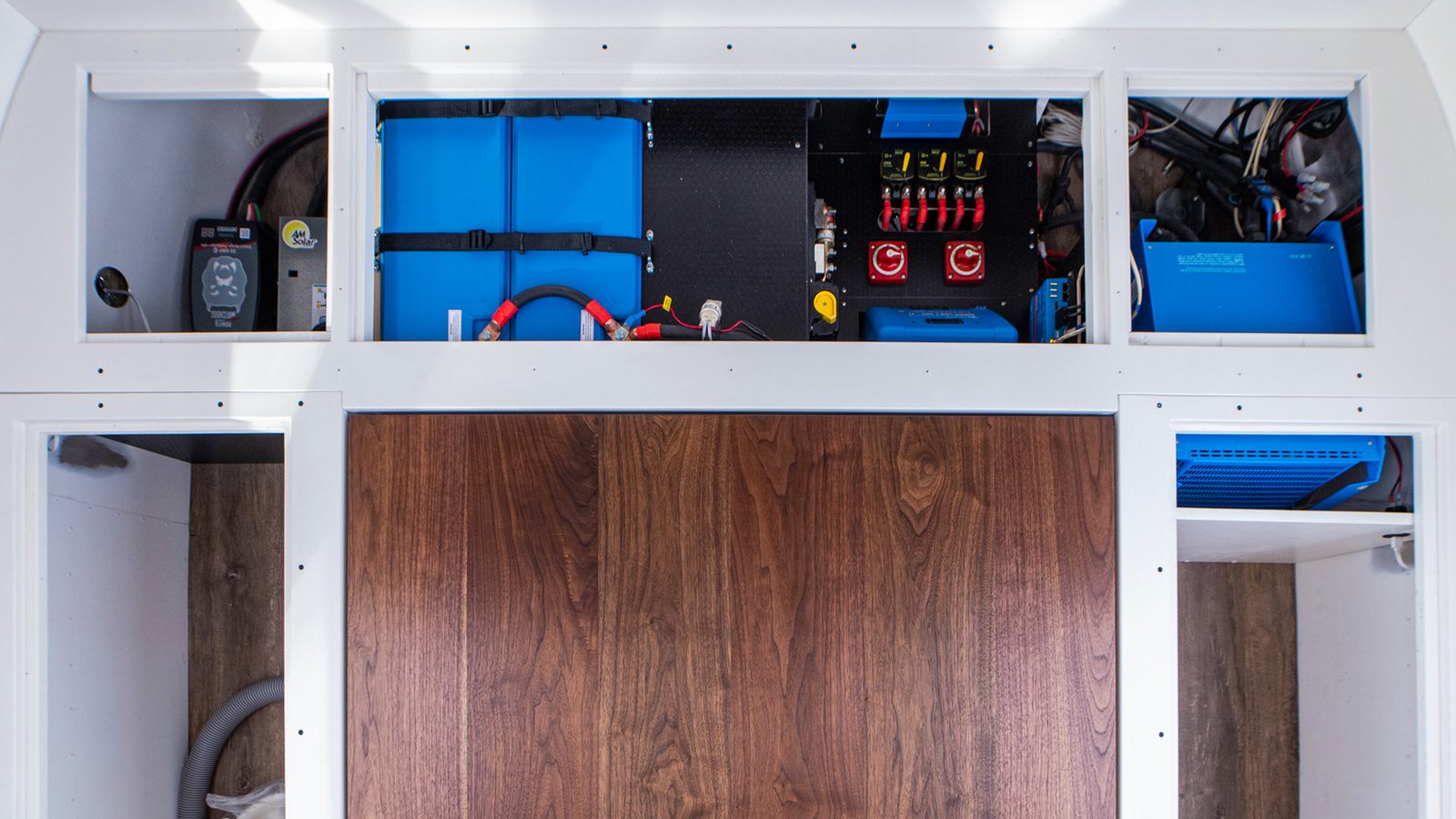
The battery bank is the heart of the system. Everything the solar panels collect gets stored here, and everything the Airstream consumes gets pulled from here. We're running 800 amp-hours of lithium iron phosphate (LiFePO4) batteries, configured and installed with help from AM Solar.
Lithium was a non-negotiable. Lead-acid batteries are cheaper, but they're heavier, they only give you about 50% of their rated capacity before you risk damage, and they degrade faster. Lithium gives you the full rated capacity, weighs roughly half as much, charges faster, and lasts thousands of cycles. In an Airstream where every pound matters, the weight savings alone justified the cost.
800Ah at 12 volts is 9,600 watt-hours of usable capacity. In practical terms, that means we can run the Airstream for about two full days without any solar input at all. Lights, fridge, water pump, charging devices, running the furnace blower. On a normal day with solar contributing, the batteries rarely drop below 70%.
Inverter: Victron MultiPlus 3000W
The inverter converts 12V DC battery power to 120V AC household power. We went with the Victron MultiPlus 3000W, which is both an inverter and a charger. When we're plugged into shore power at an RV park, it charges the batteries. When we're off-grid, it inverts battery power to AC.
3,000 watts of continuous power means we can run the air conditioning, the washer-dryer, the microwave, and charge everything simultaneously. The MultiPlus also has a transfer switch built in, so the switch between shore power and battery power is automatic. Plug in, and it charges. Unplug, and it inverts. No manual switching, no interruption.
I chose Victron across the board because their components talk to each other. The charge controllers, the inverter, and the battery monitor all communicate over a shared bus. I can see the entire system's status from my phone: how much solar is coming in, how much power is going out, battery state of charge, estimated time remaining. When you're parked in the middle of nowhere with two sleeping kids, that visibility matters.
Distribution: Blue Sea Systems 360 panel
The distribution panel is a Blue Sea Systems 360, which handles all the circuit breakers and fusing for the 12V DC side of the system. Every circuit in the Airstream, from the lights to the water pump to the USB outlets, runs through this panel. It's clean, it's modular, and when something trips (Calvin once managed to short a reading light by stuffing a fork into it), I can isolate and fix it without touching anything else.
The AC side uses a standard residential breaker panel. Nothing exotic. The Victron MultiPlus feeds the panel, and the panel distributes to the AC outlets, the washer-dryer, and the air conditioning unit.
Charging from the truck
Solar handles about 80% of our charging. The other 20% comes from the alternator while we're driving. Frank (our F-150) has a high-output alternator, and we run a DC-to-DC charger that takes power from the truck's electrical system and feeds it into Colletta's battery bank while we drive.
On a long driving day (6+ hours), we can put 30-40% back into the batteries from the alternator alone. Combined with solar, we've never once been in a situation where we ran out of power. Close a few times. Never out.
What I'd do differently
The system works. It works well. But if I were building it today, I'd make a few changes.
I'd go with a 24V system instead of 12V. Higher voltage means thinner wires, less current, less heat, more efficiency. When I built this in 2020, 24V lithium options were less common and more expensive. That's changed.
I'd add more solar. 940W is enough, but just enough. On overcast days in the Pacific Northwest or during short winter days in the Northeast, we sometimes had to be conscious about power usage. 1,200W would have eliminated that entirely.
I'd also wire in a dedicated circuit for the Starlink dish from day one, instead of running it off an inverter outlet. But that's a story for another post.
The total cost of the electrical system, including solar panels, batteries, inverter, charge controllers, distribution panel, wiring, fuses, and installation help from AM Solar, was somewhere north of $12,000. That's a lot. It's also the reason we could park anywhere in the country and live normally. For us, that was the whole point.