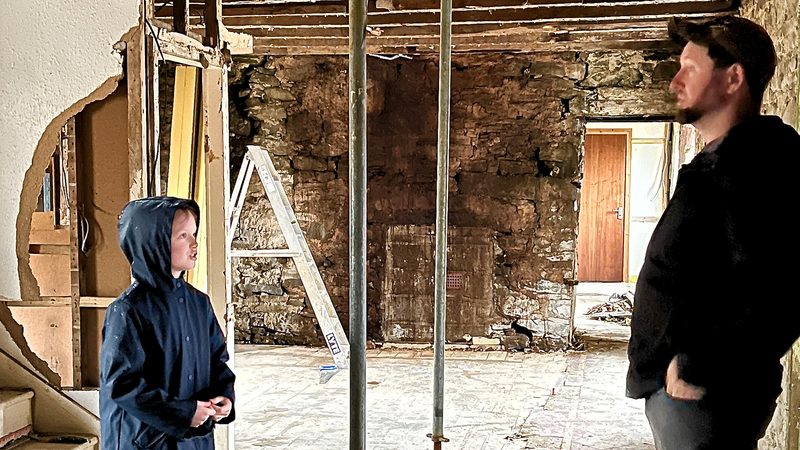
Many people were sad to see the house fully gutted, and we get it. There's something painful about watching a 200-year-old cottage get stripped back to bare stone. All that history, all those layers of wallpaper and paint and the lives lived within them, gone in a matter of days.
But this was the moment we knew we had done the right thing.
What we found behind the walls
When we peeled back the plaster in the main bedroom, there it was: a crack running from floor to ceiling through the stone wall. Not a hairline crack. Not a cosmetic blemish. A structural crack that meant the wall was slowly separating from the rest of the house.
Uncovering that crack confirmed what we'd suspected but hadn't been able to prove: a surface-level renovation would have been the bigger mistake. We could have spent months (and a lot of money) renovating around problems we hadn't even seen yet. New kitchen, fresh paint, beautiful finishes, all sitting on top of a wall that was coming apart.
Instead, we were able to deal with the structural problems properly. Which means rebuilding this wall, from the ground up, with proper foundations and lime mortar and all the care that a 200-year-old cottage deserves.
It gets worse before it gets better
I keep reminding myself of this, because the "worse" phase is real and it is long. Right now, our cottage looks like a construction site. Which it is. The roof is partially open. The interior walls are stripped to stone. There's dust everywhere. The kids help where they can, but mostly they find creative ways to disappear when the weather turns or the work gets boring.
Is it scary to rip everything out of the house you just bought? Yes. Is it exciting to finally make progress? Also yes.
The mold had to go. And honestly, what a relief. Everyone suited up and helped where they could. We went in knowing this wouldn't be a cosmetic, room-by-room renovation. Old houses don't work like that. You have to see what you're actually dealing with before you can decide what comes next.

Now the stones can breathe. And we have some big decisions ahead.
Why we stripped it back to nothing
People ask why we didn't just fix the crack and work around the rest. The answer is simple: because the crack wasn't the only problem. It was the one we could see. Behind every wall we opened, there was something else. Damp that had been sealed in, timber that had softened, lintels that weren't properly supported.
This cottage had been vacant for nine months before we got the keys, and neglected for years before that. The damp was taking over. The mold on the walls was only the tip of the iceberg.
We knew from day one this wasn't going to be a room-by-room project. It's not the most exciting part to watch. But it's the most important one.
Because the only way this house lasts another two hundred years is if we do this part right.
The bright side
We are now the proud owners of a massive pile of stone from the demolished interior walls. James has started calling it our "stone savings account." What should we build with it? A garden wall? A pizza oven? A tiny fort for the kids?
Honestly, at this point, we'll take any project that feels like building up instead of tearing down. We've been in demolition mode for weeks, and while it's necessary and satisfying in its own way, I'm ready for the part where things start coming together.
Soon. Not yet. But soon.
Follow along as we continue to renovate this old cottage and rebuild it for the next 200 years.