
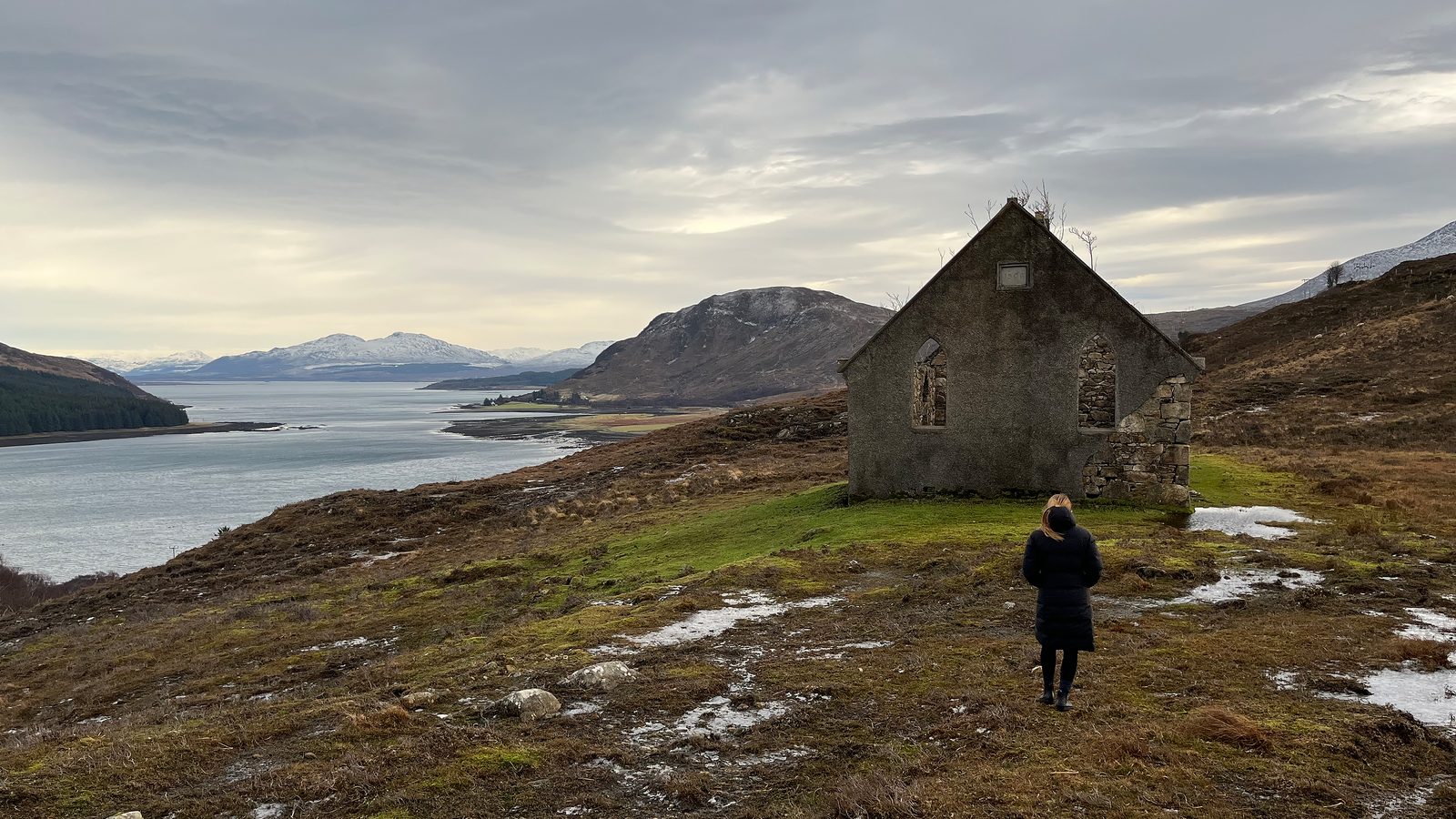
I'll be honest with you: we did not think Scotland would hit this hard.
We'd been moving through Europe for a while. The castles of the Czech Republic, the Christmas markets in Vienna, the warmth of Budapest in autumn. All of it genuinely wonderful. But when we landed in Scotland for the first time, something shifted. Maybe it was the light (that particular pewter-grey sky you only get at high latitudes). Maybe it was the smell of the sea and the peat on the wind. Or maybe it was the look on Calvin's face when he spotted our first Highland cow ambling alongside the road, completely unbothered, with horns wider than our rental car.
Whatever it was, Scotland had us from day one.
Getting the logistics right (eventually)
Let's talk about driving on the left side of the road, because even after weeks of practice it still requires active concentration. The single-track Highland roads with their little passing places every 200 metres are beautiful and terrifying in equal measure. Carol, who has driven our Airstream through Manhattan gridlock back in the States, took it in stride far more gracefully than I did. We've had to do a few creative reverses when we miscalculated a lane, and Calvin has appointed himself the official "passing place scout," calling out clearance from the passenger seat with the gravity of an air traffic controller.
We based ourselves near Golspie in Sutherland for the first week: a quiet coastal town with exactly the kind of off-season stillness we needed after months of busy European cities. We rented a cottage on the edge of the village. We could see the sea from the kitchen window and hear nothing but wind and occasional sheep.
Colletta is safe in storage back in California, waiting for our return. Meanwhile, we're adapting to Scottish weather. Slowly.
Dunrobin Castle
If you're going to be ten minutes from one of the most extraordinary castles in Europe, you go. We went twice.
Dunrobin sits on the Sutherland coast looking like something a child drew when asked to imagine a castle: fairy-tale towers, formal French-style gardens stepping down toward the sea, and a stone wall at the bottom where the water crashes in when the tide is high. It's the family seat of the Earls and Dukes of Sutherland, and it's been there (in various forms) since the 1300s.
Calvin immediately wanted to know about the battles. Amelia wanted to know about the dresses. Carol wanted to know about the architecture. I wanted to know how they heat the place. (They don't, really. You just layer up.)
The falconry display on the grounds was a proper highlight. A handler put Harris hawks, a peregrine falcon, and a barn owl through their paces while we stood in a circle in the garden with our chins up. Amelia got to hold the barn owl on a gloved fist and has talked about it approximately every day since. Calvin wanted to know if we could get a falcon. The answer is still no, Calvin.
The North Coast 500
We've now done about two-thirds of the North Coast 500 (Scotland's answer to Route 66, a 516-mile loop around the northern Highlands that takes you through some of the most dramatic landscape on the planet). We're taking it slowly, which is the only way to do it properly.
The drive from Golspie north to Thurso via Helmsdale and Berriedale is stunning in a spare, almost geological way: the land is bare and ancient, the road hugging cliff edges, the villages small and widely spaced. Helmsdale has a brilliant little heritage museum that told us more about the 19th-century Highland Clearances than any history book managed to. It's a dark chapter of Scottish history (thousands of families evicted from their land to make way for sheep), and the museum tells it without flinching. We spent two hours there and came out quieter than we went in.
Thurso is as far north as you can get on mainland Britain and it feels like it. The wind here is committed. We lost a camp chair within 20 minutes of setting it up outside our rental. We now own one camp chair.
Some places make you feel small in a way that's humbling rather than uncomfortable. The far north of Scotland is one of them.
Homeschool on the road, Highland edition
Calvin has been doing a deep-dive on Scottish history for his school unit this month, which is perfectly timed. He's working through the Jacobite risings, the Highland clan system, and the story of Bonnie Prince Charlie. Unlike most history units, he's been standing in the actual places he's reading about. We visited the battlefield at Culloden last week, which marks the end of the 1745 Jacobite uprising and, in many ways, the end of the traditional Highland clan culture.
It's one of those places where the history sits very close to the surface. The battlefield is preserved largely as it was on the day of the battle in April 1746 (open moorland, simple headstones for each clan, the wind doing the rest). Calvin walked the whole thing in silence, which, if you know Calvin, tells you everything.
Amelia, meanwhile, has been painting watercolours of Highland cows. She has a specific technique she's developed that involves a lot of orange for the fur and then adding "squiggly lines for the weather." Her portfolio is growing.
What's next
We still have the western Highlands ahead of us: Torridon, Applecross, the Isle of Skye, the Outer Hebrides if the ferry schedule works out. We're in no rush. Scotland in March is quiet and raw and honest, and we're not ready to leave the mood of it yet.
There's a particular quality to slow travel that took us a while to lean into fully: the willingness to stay somewhere past the point where you've seen all the highlights, to let a place become ordinary before you move on. Scotland is earning that. We'll stay until it feels like time to go.
More soon. There's a sea stack near Durness that I need to tell you about.